

Introduction
As organizations aggressively modernize their business applications, the boundary between transactional app development and enterprise data analytics is completely dissolving. The modern enterprise demands a unified ecosystem where application design, data engineering, and artificial intelligence seamlessly intertwine.
Historically, a Power Apps developer’s realm was clearly defined, focusing on:
- User Interface (UI/UX): Crafting responsive canvases and model-driven forms.
- Business Logic: Implementing expressions, validation rules, and automation.
- Operational Storage: Managing relational tables inside Microsoft Dataverse.
- Process Automation: Offloading background tasks to Power Automate.
However, today’s business leaders expect far more than a digital form that submits data to a ledger. They require applications that actively drive decision-making through real-time telemetry, predictive AI insights, and executive analytics.
This shift is where Microsoft Fabric becomes an indispensable pillar of the Microsoft ecosystem. For modern Power Apps developers, understanding Fabric architecture is no longer an optional “nice-to-have” skill—it is the foundation for architecting the next generation of enterprise solutions.
This article deconstructs the core architecture of Microsoft Fabric from a developer’s perspective, highlighting the essential components needed to bridge operational business apps with massive enterprise analytics.
Learning Objectives
By the end of this guide, you will master:
- OneLake Fundamentals: The unified storage concept.
- Lakehouse Architecture: Blending unstructured data flexibility with relational performance.
- Data Warehouse Concepts: Structuring massive data models for enterprise BI.
- Real-Time Intelligence: Capturing and processing live event streams.
- Power Apps & Fabric Synergy: The foundational integration patterns.
- Certification Alignment: Mapping this knowledge to your PL-900, PL-100, and DP-600 study tracks.
Why Should Power Apps Developers Care About Microsoft Fabric?
There is a lingering misconception in the tech community:
“Microsoft Fabric is exclusively for Data Engineers, Data Scientists, and Data Analysts.”
In reality, operational apps are the primary fuel for analytical engines. Consider a standard sales execution application. A Power App natively captures the day-to-day transaction records: customer profiles, deal updates, and order entries. However, leadership needs a macro view of that data, such as regional performance trends, dynamic revenue forecasting, and product churn analytics.
Without a unified architecture, achieving this requires building fragile, expensive Extract-Transform-Load (ETL) pipelines to copy data out of Dataverse into separate data lakes and warehouses. Microsoft Fabric eliminates this friction by creating a singular environment where operational applications and analytical platforms live together in harmony.
High-Level Fabric Architecture Overview
At its core, Microsoft Fabric simplifies data estate management by unifying siloed data workloads into a single, cohesive Software-as-a-Service (SaaS) platform.
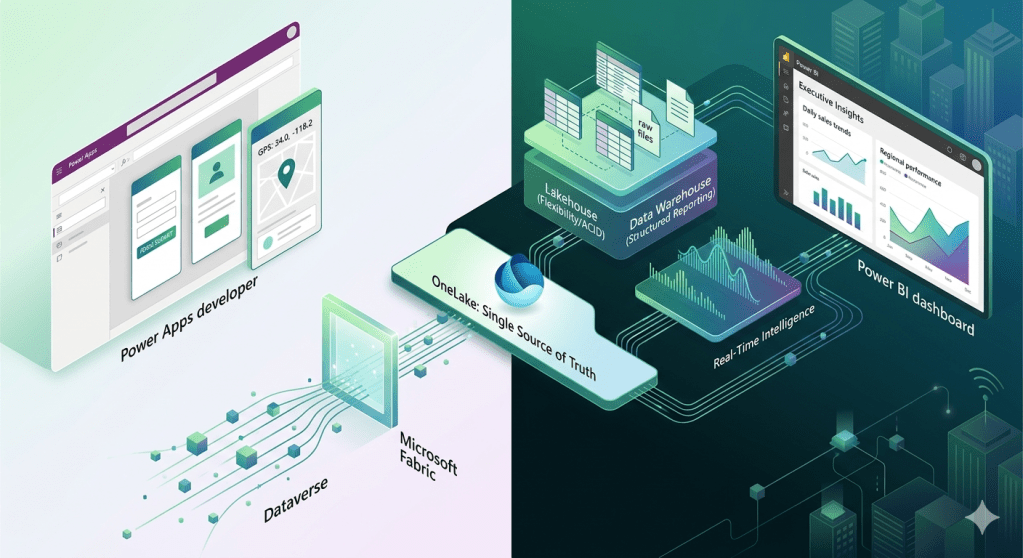
[ Power Apps ] ────> [ Dataverse ] ────> [ OneLake ] │ ┌───────────────────────┴───────────────────────┐ ▼ ▼ ▼ [ Lakehouse ] [ Data Warehouse ] [ Real-Time Intelligence ] │ │ │ └───────────────────────┬───────────────────────┘ ▼ [ Power BI ] ────> [ Business Users ]
1. OneLake: The Foundation of Every Workload
What is OneLake?
OneLake is the foundational, unified storage layer for the entire Fabric ecosystem. The easiest way to conceptualize it is to think of it as “OneDrive for Enterprise Data.” Just as OneDrive provides a single, centralized home for your personal documents, OneLake provides a single, open storage repository for an entire corporation’s data assets.
Traditional Architecture (Siloed) Fabric Architecture (Unified)┌─────────────────────────────────┐ ┌─────────────────────────────────┐│ CRM DB ──> Data Lake ──> DWH │ │ OneLake ││ (Each siloed, duplicated, and │ vs. │ (Single copy of truth used by ││ requiring separate governance) │ │ all engines simultaneously) │└─────────────────────────────────┘ └─────────────────────────────────┘
Why it Matters to Power Apps Developers:
- Zero Data Duplication: You no longer need to copy data out of your application layers into isolated reporting databases.
- Consistent Governance: Security policies, compliance regulations, and access controls are managed centrally at the storage level rather than configured separately across apps and reports.
- Simplified Architecture: Fewer integration touchpoints mean fewer breaking points in your application lifecycle management (ALM).
2. Lakehouse Architecture
What is a Lakehouse?
A Lakehouse is a modern hybrid architecture that combines the cost-effective, flexible storage of a traditional Data Lake with the structure, ACID transactions, and high performance of a traditional Data Warehouse.
- Traditional Data Lake: Excellent for storing vast volumes of raw structured, semi-structured, and unstructured data (like images or PDFs) cheaply, but notoriously slow and complex to query efficiently.
- Traditional Data Warehouse: Highly optimized for lightning-fast SQL queries and executive reporting, but rigid, expensive, and limited strictly to structured relational data.
The Fabric Lakehouse bridges this gap by saving data in an open-source, columnar storage format called Delta Parquet.
Power Apps Use Case:
Imagine you are building a field inspection application for utility infrastructure. Power Apps captures structural inspection forms (structured), high-resolution repair photos (unstructured), and raw GPS telemetry logs (semi-structured). A Fabric Lakehouse can ingest and query all of these disparate data types simultaneously in a single location, allowing you to run AI-driven image analysis alongside your structured safety reports.
3. Data Warehouse in Fabric
What is the Fabric Data Warehouse?
While a Lakehouse provides incredible flexibility for data experimentation, the Fabric Data Warehouse is built for pure relational performance. It is a fully managed, enterprise-grade relational database engine optimized for executing complex SQL queries, managing massive scale tables, and serving business intelligence layers.
Power Apps Integration Scenario:
When transactional application data scales to millions of rows, running aggregations directly inside operational databases can severely degrade app performance. By leveraging Fabric’s Data Warehouse, your Power App continuously channels transaction histories away from operational processing, allowing an optimized warehouse engine to handle executive KPIs, trend analyses, and financial closeouts without slowing down the end-user application.
4. Real-Time Intelligence
What is Real-Time Intelligence?
In a fast-paced market, waiting for a nightly batch job to process yesterday’s data is an operational liability. Real-Time Intelligence inside Fabric allows organizations to ingest, analyze, and act upon high-velocity streaming data the moment it occurs.
Traditional BI Workflow:[ Transaction ] ───> [ Nightly ETL Processing ] ───> [ Dashboard Updates Next Day ]Real-Time Fabric Workflow:[ App Event ] ───> [ Live Eventstream ] ───> [ Fabric Analytics Engine ] ───> [ Dashboard Updates in Seconds ]
Power Apps + Real-Time Intelligence Scenario:
Consider a manufacturing shop-floor tracking system. Operators use a Power App to record machine statuses, parts counts, and quality inspections. By routing these inputs directly through Fabric Eventstreams, facility managers see live operational dashboards updating in real time, triggering instant automated alerts via Power Automate the exact second an anomaly or safety threshold is crossed.
The Architecture Matrix: What to Use When
As a Power Apps developer, you don’t need to know how to write complex data engineering pipelines, but you must know which architectural layer to leverage based on the business requirement:
| Scenario / Business Need | Recommended Fabric Component | Developer Context |
| Unified Enterprise Storage | OneLake | The foundational SaaS data lake where all files, tables, and databases reside. |
| Flexible, Multi-Format Storage | Lakehouse | Ideal for combining app tables with raw, unstructured attachments, images, and files. |
| High-Performance SQL Reporting | Data Warehouse | Best for traditional corporate reporting, multi-year financial ledgers, and complex star-schemas. |
| Instant Streaming Telemetry | Real-Time Intelligence | Essential for IoT monitoring, immediate security alerts, and live operational scorecards. |
The Modern Enterprise Integration Pattern
The gold standard for modern, enterprise-scale Microsoft deployments utilizes an elegant, end-to-end architecture pattern that chains operational apps directly into analytical insights:
$$\text{Users} \longrightarrow \text{Power Apps} \longrightarrow \text{Dataverse} \longrightarrow \text{Fabric OneLake} \longrightarrow \text{Lakehouse/Warehouse} \longrightarrow \text{Power BI} \longrightarrow \text{Executives}$$
Real-World Example: Sales Performance Platform
- Power Apps (Canvas & Model-Driven): Sales reps interact with the UI to advance pipeline stages, update opportunity details, and log client interaction notes.
- Microsoft Dataverse: Safely retains the highly secure, transactional data, managing immediate relational business logic and row-level security.
- Fabric Lakehouse: Automatically synchronizes with Dataverse (via native, zero-ETL Link to Fabric) to historical sales records, external market data, and unformatted contract documents.
- Fabric Warehouse: Structures clean, processed historical metrics to calculate rolling quarterly commissions, regional win-loss ratios, and growth margins.
- Power BI: Visualizes the warehouse datasets into dynamic executive dashboards, giving leadership instant clarity on future revenue forecasts.
Certification Alignment Check
If you are studying for your Microsoft certifications, understanding this architecture directly addresses core objectives across multiple certification tracks:
- PL-900 (Power Platform Fundamentals): Recognizing how the Power Platform fits into the broader Microsoft SaaS ecosystem, specifically connecting Dataverse with Power BI.
- PL-100 (Power Platform App Maker): Designing data models that smoothly transition from simple front-end inputs to enterprise-capable storage solutions.
- DP-600 (Implementing Analytics Solutions Using Microsoft Fabric): Mastering the configurations of OneLake, Lakehouses, Warehouses, and streaming analytics for organizational deployment.
Key Takeaways
- OneLake is the anchor of Microsoft Fabric, acting as a single, centralized source of truth for the entire enterprise data estate.
- Lakehouses merge open flexibility with speed, combining raw file storage with structured table querying capabilities.
- Data Warehouses maximize relational power, serving as the ideal engine for high-performance enterprise BI and corporate reporting.
- Real-Time Intelligence destroys latency, shifting data processing from historical batch jobs to instant, active insights.
- The future of app development is data-driven. Successful Power Apps developers must think beyond the user interface and architect solutions that feed directly into analytical ecosystems.
What’s Next?
Article 3: Connecting Power Apps with Microsoft Fabric Lakehouse – An End-to-End Implementation Guide
In our next deep-dive article, we will move past pure theory and start building. We will cover:
- Provisioning and setting up your first Fabric Lakehouse.
- Configuring the native, zero-ETL link between Microsoft Dataverse and Fabric.
- Designing robust data ingestion patterns.
- Constructing an end-to-end Employee Management Solution to see the architecture in action.
Stay tuned and get ready to build! 🚀
Discover more from Common Man Tips for Power Platform, Dynamics CRM,Azure
Subscribe to get the latest posts sent to your email.

